
Knife Blade Grinds Explained: How Edge Geometry Affects Performance
Written by Juan Arango | Former Colombian Army Infantry Officer
Last Updated: March 2026
Quick Answer: The blade grind (the cross-sectional shape ground into the steel) affects cutting performance more than most people realize. A flat grind is the most versatile for everyday use. A hollow grind gives you the sharpest slicing edge. A convex grind is the toughest for heavy chopping. Match the grind to what you're actually doing with the knife.
Find Your Grind
You've picked a blade shape. You've figured out the steel. Now the product page says "full flat grind" or "hollow grind" or "scandi," and you're not sure what that changes about how the knife actually cuts.
Here's the short version: if steel determines how long an edge lasts, the grind determines how that edge performs. Two knives in the exact same steel, with the exact same blade shape, will cut completely differently if one has a hollow grind and the other has a convex grind.
The grind is the geometry of the blade. It's how the steel is shaped from the spine down to the cutting edge. It controls how the blade moves through material, how much effort each cut takes, and how the edge holds up under stress.
The good news: there are only seven grinds you'll actually encounter on production knives, and once you understand the tradeoffs, picking the right one is straightforward.
Quick Grind Recommendations by Use
Need a recommendation right now?
EDC / General Purpose: Flat grind, hollow grind
Tactical / Hard Use: Saber grind, convex grind
Hunting / Field Dressing: Hollow grind, flat grind
Bushcraft / Woodwork: Scandi grind, convex grind
Chopping / Batoning: Convex grind
Not sure? A flat grind is the safest all-around choice. It does everything reasonably well and nothing badly.
Want a portable reference for knife steels too? Download our free Steel Comparison Chart →
Jump to a Section
- Flat Grind
- Saber Grind
- Hollow Grind
- Scandi Grind
- Convex Grind
- Chisel Grind
- Compound Bevel
- Comparison Chart
- Match Grind to Use
- How Grind and Steel Work Together
- FAQs
Why the Grind Matters
Think of the grind as the blade's cross-section. If you sliced the knife in half and looked at it end-on, the grind is the shape you'd see.
That shape determines three things:
Cutting efficiency: How easily the blade moves through material. Thinner geometry means less resistance, which means less effort per cut.
Edge durability: How well the edge holds up under stress. Thicker geometry behind the edge means more steel supporting the cutting edge, which means more resistance to chipping and rolling.
Ease of sharpening: How much steel you need to remove to restore the edge. Some grinds are simple enough to sharpen on a flat stone. Others need specialized equipment.
These three properties trade off against each other, just like the tradeoffs in knife steel. A grind that slices effortlessly through rope will chip if you baton wood. A grind that survives heavy impacts won't glide through cardboard. Every grind is a compromise.
Understanding these tradeoffs will also help when you're choosing the right steel, because certain grinds pair better with certain steels.
The Seven Blade Grinds
Flat Grind
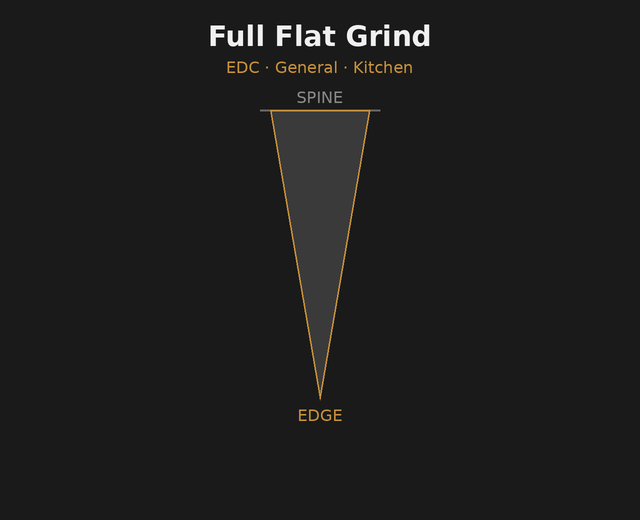
The flat grind tapers evenly from the spine straight down to the cutting edge. The blade's cross-section forms a simple V shape, thin at the edge and widening steadily to the spine. This creates thin, efficient geometry and the blade slices through material with minimal resistance.
The tradeoff is durability. Less steel behind the edge means less support for the cutting edge, so a full flat grind isn't ideal for heavy impact tasks like batoning or prying. But for anything where cutting efficiency matters (opening packages, slicing food, cutting cordage), a flat grind is the right tool.
The flat grind is also one of the easiest to sharpen. The flat bevel sits naturally against a flat stone, so you don't need specialized equipment or technique. If you're not sure what grind to get, a flat grind is the safest all-around choice.
Looking for the saber grind (partial flat grind)? It has its own section below.
Best for: EDC, general utility, kitchen knives, all-purpose use
Strengths: Versatile, excellent cutting performance, easy to sharpen on flat stones, widely available
Weaknesses: Can be fragile at the edge on harder steels, not ideal for heavy impact or prying tasks, less durable than thicker grinds under hard use
Commonly found on: Benchmade Bugout, Spyderco Tenacious, Spyderco Tenacious Combo Edge, Spyderco Endura 4, Spyderco Shaman, Kershaw Iridium, Kershaw Iridium Reverse Tanto, SOG Aegis FX, TOPS C.U.T. 4.0, most chef's knives, many production folders
Steel pairing: Full flat grinds benefit from steels with good toughness like S35VN or 154CM to compensate for the thinner edge geometry. Avoid very hard, brittle steels on thin flat grinds — the geometry doesn't leave enough steel to support a chippy edge. Compare these steels →
Sharpening: Straightforward on flat stones or guided systems. The bevel sits naturally against any flat surface and is one of the easiest grinds to maintain. See our sharpening guide →
Saber Grind
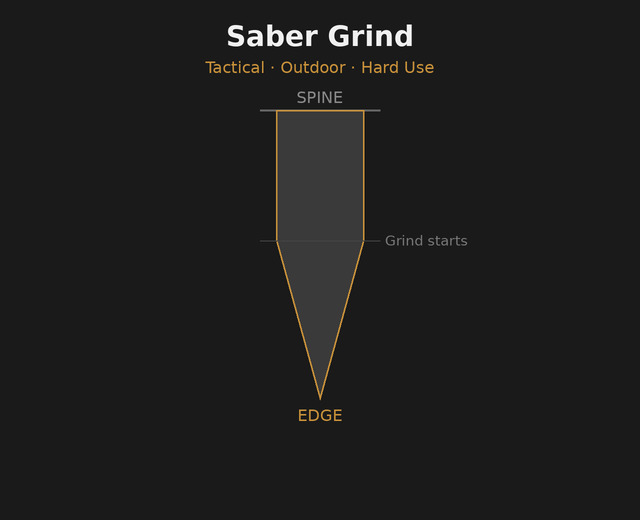
The saber grind (sometimes called a partial flat grind) tapers from roughly the midpoint of the blade down to the cutting edge, leaving the upper half of the blade at full thickness.
That thick stock near the spine is the whole point. It keeps more steel in the blade where it matters for strength, making the saber grind significantly more durable than a full flat grind under hard use. The tradeoff is cutting efficiency. Because the blade is thicker behind the edge, it pushes material apart more during cuts instead of slicing cleanly through it.
This is the grind you'll see on most tactical and military knives, and for good reason. When a knife might be used for prying, batoning, or cutting through tough material under stress, you need an edge that won't chip or roll on impact. The saber grind delivers that reliability. It won't glide through cardboard like a full flat grind, but it'll still be cutting when a thinner grind has given up.
The saber grind also adds structural rigidity to the blade. Because the upper portion stays at full stock thickness, the blade flexes less. This matters in larger fixed blades and hard-use folders where blade flex could be a safety issue.
Best for: Tactical use, outdoor and survival knives, hard-use fixed blades
Strengths: Strong and durable, resistant to chipping and rolling under impact, adds blade rigidity, easy to sharpen on flat stones
Weaknesses: Thicker geometry behind the edge reduces slicing efficiency, not ideal for detailed or precision cutting, pushes material apart on thicker cuts
Commonly found on: ESEE knives, Ka-Bar USMC, many TOPS knives, Cold Steel tactical line, most military-issue fixed blades
Steel pairing: The extra steel behind the edge means you can pair a saber grind with harder, more wear-resistant steels without worrying about chipping. S30V, 1095, and D2 are all excellent choices. For maximum toughness on a hard-use fixed blade, pair it with 3V or 5160.
Hollow Grind
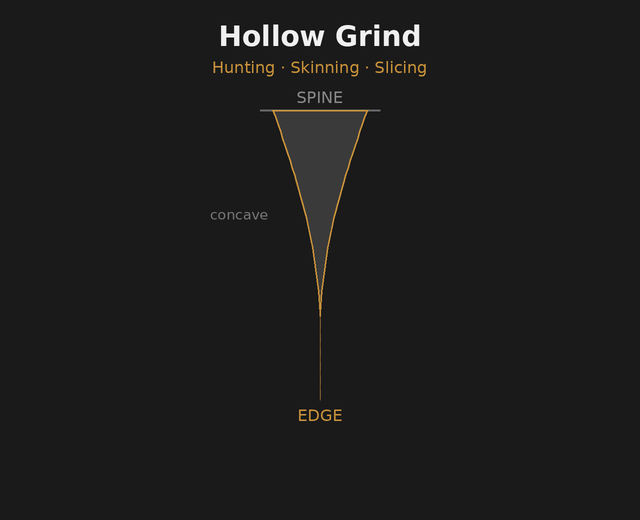
The hollow grind has a concave curve swept into the blade, creating an edge that's extremely thin right at the cutting surface. Imagine pressing the blade against a large cylinder and grinding and you will see how the shape is created.
The result is the sharpest possible edge geometry. The concave shape means almost no steel right behind the edge, so the blade slices through material with very little resistance. It's the grind of choice for anything where sharpness matters more than durability: skinning game, precision cutting, shaving.
The tradeoff is durability. That thin edge geometry means less metal supporting the cutting edge. A hollow grind can chip or roll if you hit something hard, try to baton, or use the knife for prying. It's a specialist, not a generalist.
Best for: Hunting, skinning, slicing, precision work
Strengths: Extremely sharp, excellent slicing performance, great for detailed cuts
Weaknesses: Fragile edge that chips more easily under impact, poor for hard use or chopping, blade can wedge in thick material because the bevel curves inward
Commonly found on: Buck 110, Kershaw Leek, Kershaw Link, most traditional hunting knives, straight razors, many classic folders
Steel pairing: Pairs best with steels that balance edge retention and toughness. VG-10 and 14C28N are excellent choices: they take a razor edge and are easy to touch up when the thin edge inevitably needs maintenance. Avoid very hard, brittle steels like M390 on hollow grinds, since the thin geometry combined with hard steel increases chipping risk. Compare these steels →
Sharpening: The concave surface can be tricky on flat stones since the curve doesn't sit flush. Works best with round or tapered sharpening rods, or with a strop for maintenance. See our sharpening guide →
Scandi Grind
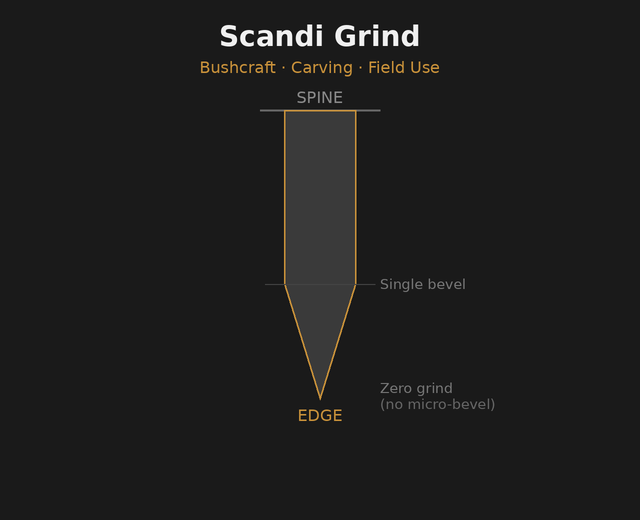
The scandi (Scandinavian) grind is a single, flat bevel that runs from roughly the middle of the blade straight to the edge with no secondary bevel. What you see is the actual cutting edge, with no micro-bevel added after grinding.
This simplicity is the entire point. Because the bevel itself is the edge, you can lay the flat bevel directly on a stone and sharpen by feel. No angle guides needed, no guessing. The grind tells your hands exactly where to hold the knife. This makes the scandi grind the easiest to sharpen in the field, which is why it has been the standard in Scandinavian bushcraft for generations.
The tradeoff is edge retention. A zero-ground edge (no secondary bevel) is more delicate than a compound edge. The scandi grind dulls faster than most other grinds, and it doesn't perform as well on slicing tasks because the relatively thick geometry behind the edge creates more resistance in material.
Where it excels is woodwork. The flat bevel gives you precise control for carving, feathersticking, and detailed work. You can register the bevel flat against the wood and make controlled, accurate cuts. No other grind gives you this level of tactile feedback.
Best for: Bushcraft, wood carving, feathersticking, field sharpening
Strengths: Easiest grind to sharpen (just lay the bevel flat), excellent control for woodwork, simple and effective
Weaknesses: Dulls faster than compound grinds, not great for slicing tasks, thick geometry creates drag in material
Commonly found on: Mora knives, most Scandinavian bushcraft knives, many fixed-blade outdoor knives
Steel pairing: Best with easy-to-sharpen carbon steels like 1095 or simple stainless like 14C28N. The whole point of a scandi grind is field maintenance. Don't pair it with a steel that requires diamond stones. A Mora in 14C28N is the classic example of this pairing done right. Compare these steels →
Convex Grind
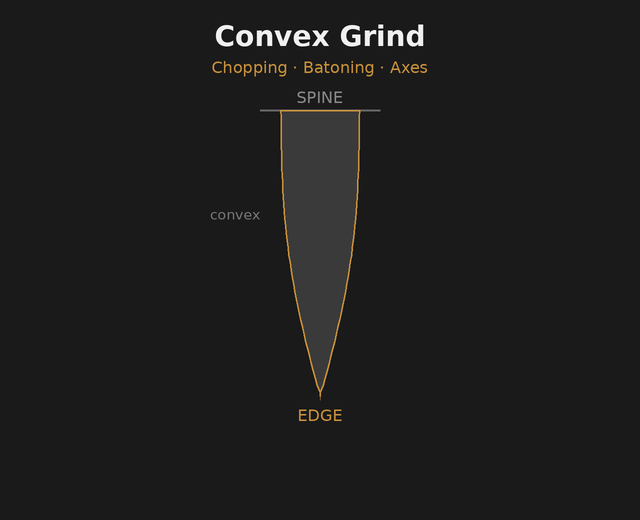
The convex grind is the opposite of the hollow grind in almost every way. Instead of curving inward toward the edge, the bevel curves outward, a rounded, continuous arc that runs from the spine down to a fully convex apex. There is no flat secondary bevel. The edge itself is slightly rounded rather than coming to a sharp V.
That geometry has real consequences for how the knife performs. The extra material behind the edge gives it exceptional strength. Convex edges chip and roll less than thin hollow or flat grinds under hard impact. For chopping, splitting, or heavy field use where edge durability matters more than pure slicing performance, the convex holds up better.
On the other hand, the rounded apex does not bite into material as aggressively on the initial stroke. For slicing tasks that demand fine, clean cuts, a well-sharpened flat grind will typically outperform a convex.
Best for: Chopping, splitting, hard-use field tasks, outdoor and bushcraft work where edge durability under impact matters more than fine slicing performance
Strengths: Exceptional edge durability, resists chipping and rolling under impact, strong geometry behind the edge
Weaknesses: Less aggressive initial bite on slicing tasks, requires freehand sharpening to maintain the convex geometry (standard V-guides and pull-through tools will flatten it over time)
Commonly found on: Bark River knives, axes, machetes, purpose-built bushcraft blades designed for sustained hard use
Steel pairing: Tougher steels with good impact resistance suit the convex grind well. 1095 high carbon and similar alloys complement the geometry for hard-use applications. The convex edge already handles chipping well; pairing it with a brittle high-hardness steel works against that advantage. Compare these steels →
Sharpening: The most skill-intensive grind to maintain. Standard V-guide sharpeners and pull-through tools will not preserve the rounded geometry. They gradually flatten it into a different grind. Proper maintenance requires freehand work on a strop or a slightly flexible abrasive surface. If you are not comfortable with freehand sharpening, factor this in before choosing a convex-ground blade. See our sharpening guide →
Chisel Grind
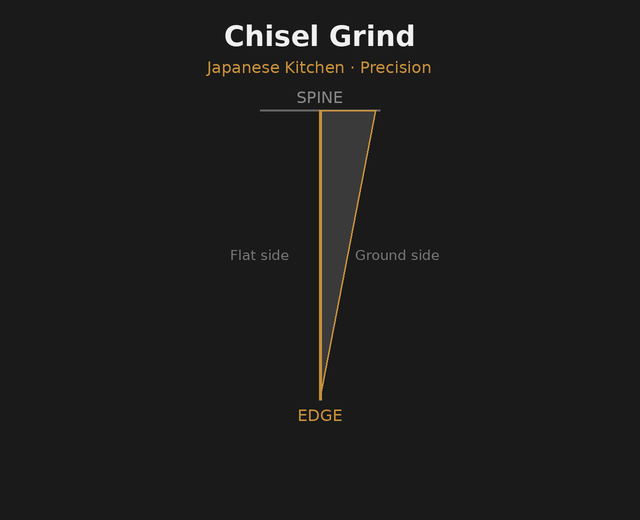
The chisel grind is ground on only one side of the blade. The other side is completely flat, like a wood chisel or a plane blade. That asymmetry produces an extremely thin, extremely sharp edge, sharper at a given angle than most symmetrical grinds can achieve.
The flat side can register against a cutting surface and make perfectly controlled, repeatable cuts. This is why Japanese single-bevel kitchen knives (yanagiba, usuba, deba) have used chisel grinds for generations. When precision matters more than versatility, the geometry delivers.
Some tactical knives use chisel grinds as well, with the argument being an aggressive initial cut and simplified one-sided sharpening. The counter-argument is that the asymmetric edge pulls toward the flat side during cutting, which takes adjustment, and it only works well for one hand.
Best for: Japanese kitchen work, precision slicing, specific tactical applications where an aggressive single-bevel edge is the priority
Strengths: Extremely sharp, precise cuts, only need to sharpen one side, simple edge maintenance once you understand the technique
Weaknesses: Cuts pull to one side (not ambidextrous), less versatile than symmetrical grinds for general tasks, can be difficult to control for everyday cutting
Commonly found on: Japanese single-bevel kitchen knives, some Emerson knives, some custom tactical knives
Steel pairing: Best with harder steels that hold an acute single-bevel edge. In the Japanese kitchen tradition that means VG-10, SG2, or high-carbon white and blue steel. For tactical chisel grinds, tougher steels like 154CM or D2 handle stress better at the edge. Compare these steels →
Sharpening: Work the beveled side only, then lay the flat side on your stone just long enough to remove the burr. Simpler than sharpening a symmetrical grind in theory, but keeping the flat side truly flat requires a good stone and consistent discipline. The technique is straightforward once you understand it; the challenge is not cutting corners on the flat side. See our sharpening guide →
Compound Bevel (Double Bevel)
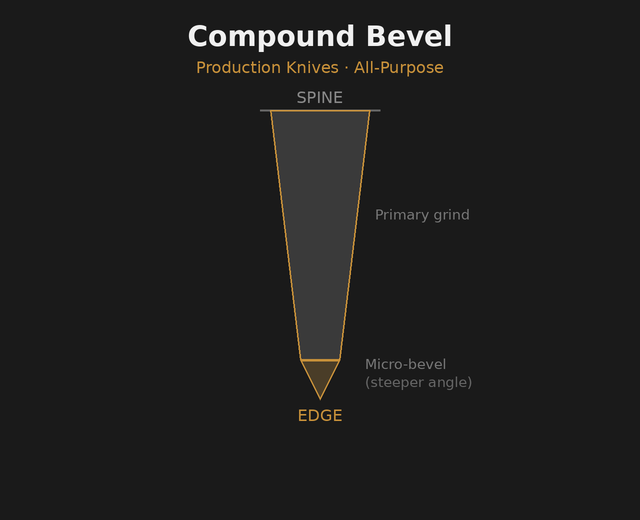
The compound bevel combines two different angles on the same blade. A primary grind (usually flat or hollow) brings the blade down from the spine, and then a secondary micro-bevel at a steeper angle forms the actual cutting edge.
This is the most common grind on production knives, even though it is rarely advertised. Most "flat grind" knives actually have a secondary bevel added at the factory: the flat grind creates the blade geometry, and then a sharper angle is applied right at the edge.
The secondary bevel reinforces the cutting edge. By adding a slightly steeper angle at the very tip, you get the cutting efficiency of the primary grind with the edge durability of a blunter angle. It is the best of both worlds, which is why most production knives use it.
Best for: Production knives of all types, general use, any situation where balance between sharpness and durability matters
Strengths: Combines cutting efficiency with edge durability, easy to maintain (sharpen the micro-bevel only), most versatile overall approach
Weaknesses: Slightly less sharp than a zero-ground edge like the scandi, slightly less slicing ability than a pure hollow grind, the secondary bevel grows wider with repeated sharpening unless occasionally reprofiled
Commonly found on: TOPS Knives Sky Marshall (dual grind tanto geometry), most production knives. This is the default.
Steel pairing: Works with anything. The compound bevel is designed to optimize whatever steel it is applied to. Harder steels like S30V and M390 benefit because the micro-bevel adds durability at the edge. Softer steels like 8Cr13MoV and AUS-8 benefit because the steeper edge angle compensates for lower wear resistance. Compare these steels →
Sharpening: Maintain the micro-bevel, which is typically the angle you are already sharpening at. Every few years, depending on use, you may want to reprofile the primary bevel to keep the overall edge geometry performing well. See our sharpening guide →
| Grind | Cutting Ability | Edge Durability | Ease of Sharpening | Best Use |
|---|---|---|---|---|
| Full Flat | ★★★★☆ | ★★★☆☆ | ★★★★☆ | EDC, general, kitchen |
| Saber | ★★★☆☆ | ★★★★☆ | ★★★★☆ | Tactical, outdoor, hard use |
| Hollow | ★★★★★ | ★★☆☆☆ | ★★★☆☆ | Hunting, skinning, slicing |
| Scandi | ★★★☆☆ | ★★★☆☆ | ★★★★★ | Bushcraft, carving, field use |
| Convex | ★★★☆☆ | ★★★★★ | ★★☆☆☆ | Chopping, batoning, axes |
| Chisel | ★★★★☆ | ★★★☆☆ | ★★★★☆ | Japanese kitchen, precision |
| Compound Bevel | ★★★★☆ | ★★★★☆ | ★★★★☆ | All-purpose, production knives |
Ratings are relative to other blade grinds, not absolute measures.
Matching Grind to Your Use Case
EDC / General Purpose
Priority: Versatility and easy maintenance
You need a knife that handles everything from opening packages to cutting cordage to minor food prep. You want an edge you can maintain easily without specialized equipment.
Recommended: Full flat grind or compound bevel
Tactical / Self-Defense
Priority: Edge durability under stress
The edge needs to hold up when things go wrong. Chipping or rolling under impact is not acceptable.
Recommended: Saber grind or convex grind
Hunting / Field Dressing
Priority: Slicing performance
You'll be making long, precise cuts through hide and connective tissue. The edge needs to stay thin and sharp through the work.
Recommended: Hollow grind or full flat grind
Bushcraft / Woodwork
Priority: Control and field maintenance
Carving, feathersticking, and detail work require a grind that gives you tactile feedback and registers predictably against material. Sharpening with minimal equipment in the field is essential.
Recommended: Scandi grind
Chopping / Heavy Outdoor Work
Priority: Toughness above all else
You are batoning wood, clearing brush, or processing firewood. The edge will take impacts that would destroy thinner grinds.
Recommended: Convex grind
How Grind and Steel Work Together
The grind and the steel are not independent choices. They interact, and the right combination amplifies both. The wrong combination can cancel out the advantages of each.
Thin grinds need tougher steels. A full flat grind or hollow grind puts less steel behind the edge. If you pair that with a very hard, brittle steel, the edge is more likely to chip. This is why many flat-ground EDC knives use S35VN (tough) rather than M390 (harder but more brittle). The grind already maximizes cutting performance — the steel needs to provide durability.
Thick grinds can handle harder steels. A convex or saber grind has plenty of steel supporting the edge. You can afford to use a harder, more wear-resistant steel because the geometry compensates for brittleness. This is why you will see S30V and even M390 on saber-ground tactical knives, as the thick geometry prevents chipping.
Easy-to-sharpen grinds deserve easy-to-sharpen steels. A scandi grind is designed for field sharpening. Pairing it with M390 defeats the purpose, as you would need diamond stones to sharpen a grind that is meant to be maintained on a creek rock. Match a scandi with 1095 or 14C28N and you get a knife you can maintain anywhere with almost anything.
Edge angle matters as much as grind type. Research into blade geometry consistently shows that reducing your edge angle can dramatically increase edge retention. The performance gain from maintaining a proper edge angle on a flat grind in basic steel will often outperform a neglected edge on a convex grind in premium steel.
For a deep dive into how different steels perform, read our complete knife steel guide →
What Grind Doesn't Tell You
Heat Treatment Still Matters Most
Just like with steel selection, a well-executed blade in a lesser grind will outperform a poorly made knife with a better grind. The grind is only as good as the execution. Factory grinds from reputable makers like Benchmade, Spyderco, and TOPS are consistent and well-done. Cheap knives often have uneven grinds that look right but do not perform.
Blade Shape Matters Too
The grind is the cross-section. The blade shape is the profile — drop point, tanto, clip point, and so on. Both affect cutting performance. A hollow-ground drop point will behave very differently from a hollow-ground tanto, even though they share the same grind. Consider both together, not separately.
Read our blade shapes guide → to understand how profile and grind interact.
You Can Change the Grind (Sort Of)
Technically, you can reprofile a blade's grind — grind a flat grind into a convex, or add a compound bevel to a scandi. But this requires skill, equipment, and removes steel permanently. It is usually better to buy the right grind upfront than to try to modify one later.
Frequently Asked Questions
-
A blade grind is the cross-sectional shape ground into the steel from the spine to the cutting edge. It determines how the knife cuts, how durable the edge is, and how easy it is to sharpen. The seven common grinds are flat, saber, hollow, scandi, convex, chisel, and compound bevel.
-
The scandi grind is the easiest to sharpen. Because the bevel itself is the cutting edge with no secondary bevel, you simply lay the flat bevel on a stone and stroke. The grind tells your hands the correct angle — no guides or guesswork needed. Even a beginner can get a sharp edge in a few minutes.
-
A flat grind tapers evenly from spine to edge in a straight line, creating a versatile V-shaped cross-section. A hollow grind has concave curves swept into the blade, creating thinner geometry right at the edge for superior slicing performance. The hollow grind is sharper but more fragile, while the flat grind is more versatile and durable.
-
They matter roughly equally, but in different ways. The grind determines how the knife cuts. The steel determines how long it keeps cutting. Blade geometry (grind + edge angle) typically has a bigger impact on cutting performance than steel type. But steel has a bigger impact on maintenance frequency and edge durability.
-
Usually. Look at the blade in profile (edge toward you). A hollow grind has a visible concave curve. A flat grind has straight, even tapers. A convex grind has a subtle outward curve. A scandi grind has a wide, flat bevel with no secondary edge. It gets harder to distinguish between a flat grind and a compound bevel without close inspection.
The bottom line
Blade grind is one of the three pillars of knife performance — along with steel choice and blade shape. Understanding grinds helps you predict how a knife will actually cut, not just how long it will stay sharp.
The quick version:
- Flat grind for versatility
- Hollow grind for sharpness
- Scandi grind for simplicity
- Convex grind for toughness
- Chisel grind for precision
- Compound bevel for balance
Pick the grind that matches how you'll actually use the knife. Then match the steel to the grind. Then maintain the edge. That combination — the right grind, the right steel, and consistent maintenance — matters far more than any single spec on a product page.
Email Juan — he answers every message.
Related guides
Blade grind is one piece of the puzzle. These guides cover the other two:
- Knife steel types guide — how to match steel to your carry style and budget
- Knife blade shapes guide — how profile affects cutting performance and use case
Download the free steel comparison chart
A printable reference covering the most common EDC knife steels — edge retention, corrosion resistance, and value at a glance. Get the free chart.
Sources & further reading
Knife Steel Nerds (knifesteelnerds.com) — Larrin Thomas, PhD metallurgist. His research on edge geometry and retention informed the grind-steel pairing recommendations in this guide.
Benchmade Knife Company — Manufacturer specs and grind profiles on their production knives.
Bark River Knives — One of the best references for convex grind design and performance.
Mora Knives — The standard-bearer for Scandinavian grind design and field knife philosophy.