
Olight vs Nitecore: Which Brand Is Right for Your EDC?
Introduction
I've carried the Olight Arkfeld Pro every day for over a year. Dropped it. Run it over with a vehicle. It kept working. That tells you something about the brand, and it should also say something about this guide. I'm not choosing sides. I honestly believe that both brands make excellent lights. They just make them for different people.
If you're looking for a flat EDC pocket light you'll actually carry every day, Olight is a great choice. If you need massive output, tactical features, or a headlamp for operational use, Nitecore is where to look. This guide will tell you why.
01 — The brands: what each one actually does
Olight was founded in 2006 and has built its reputation on consumer-friendly EDC lights that are compact, rechargeable, and well-finished, with magnetic charging and lifetime warranty support for US purchases. They're Chinese-made, which raises eyebrows in the EDC community. In my opinion, this concern is overblown at this point, just like what happened with Holosun. A year of daily carry, drops, and abuse on the Arkfeld Pro has not produced a single failure.
Nitecore has been making flashlights since 2004 and has always leaned toward technical and tactical users, with a big focus on law enforcement, search and rescue, and military. Their lineup includes headlamps, keychain lights, and tactical EDC lights with features like OLED displays, real-time runtime readouts, and NVG-compatible headlamps. They are also Chinese-made.
Both are legitimate brands with real track records. The difference is who they're building for.
02 — Form factor: what you'll actually carry
This is where the brands diverge most clearly.
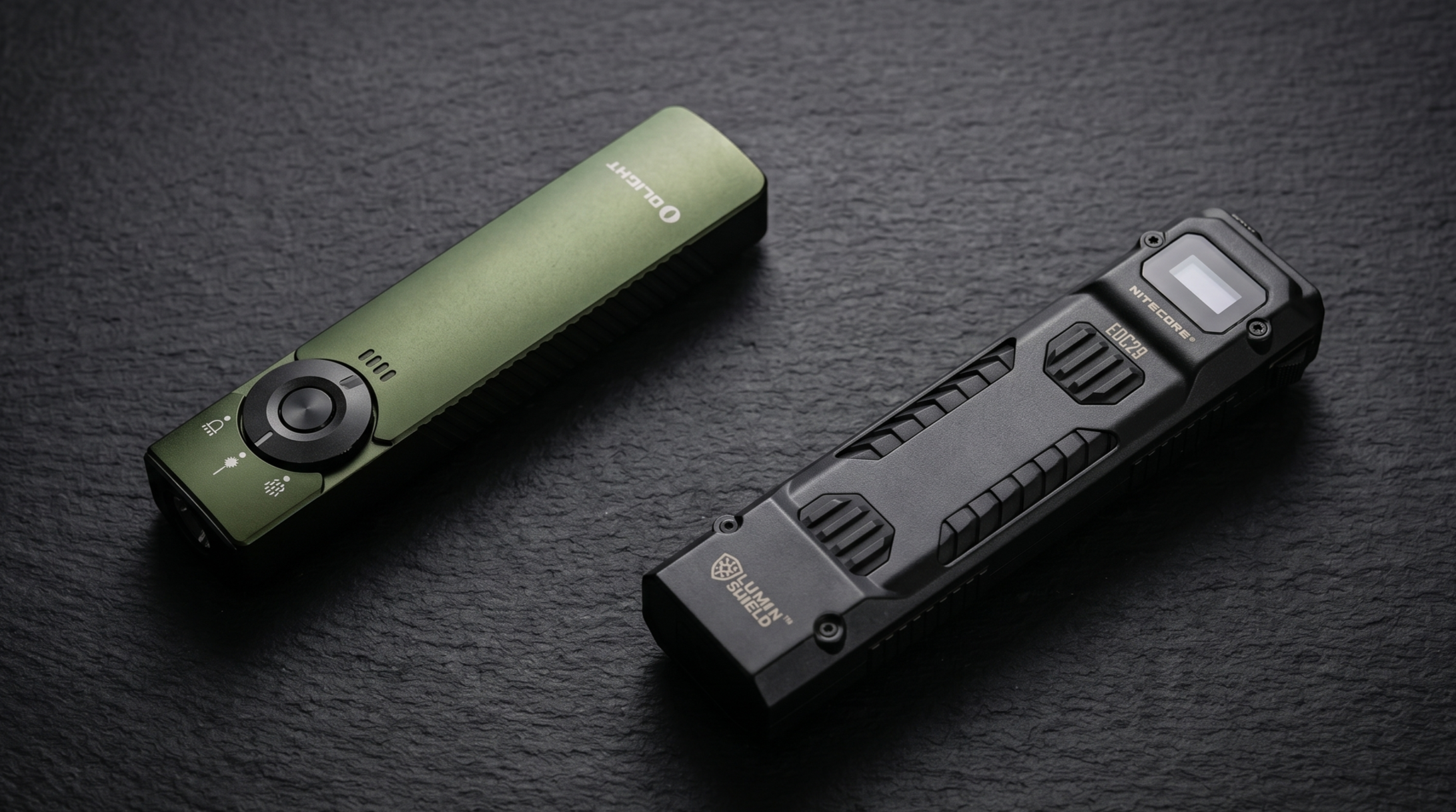
Olight's Arkfeld Pro is flat, roughly the same footprint as a TV remote, designed to sit in your pocket without printing or adding bulk. At 3.92 oz and 4.72" long with a 0.62" profile, it's genuinely pocketable alongside a wallet and keys. The flat form factor is deliberate. Most EDC flashlights are cylinders, which roll off surfaces and create an obvious pocket bulge. The Arkfeld Pro doesn't.
Nitecore's EDC29 is also a flat-profile light, but it's a different category entirely. At 5.26" and 5.64 oz with stainless steel construction and a titanium PVD coating, it's heavier and more purposeful. It's built for someone who wants maximum output in a packable form, not someone who wants to forget it's in their pocket.
03 — Output: lumens, runtime, and what actually matters
The spec gap here is significant and worth understanding honestly.
The Arkfeld Pro delivers 1,300 lumens at turbo, steps down to 420 lumens after about four minutes, and has a moonlight mode that runs for 11 days. Five brightness levels cover the full range from task lighting to emergency use. The built-in 1,500mAh battery charges via magnetic connector.
The Nitecore EDC29 hits 6,500 lumens in Lumin Shield mode, drops to a 3,000-lumen Search spotlight, and steps down through High (1,200 lumens, 2 hours), Mid (400 lumens, 3 hours), Low (100 lumens, 13 hours), and Ultralow (15 lumens, 61 hours). It charges via USB-C and reaches full charge in about 1 hour 15 minutes.
The real take on the EDC29: the 6,500-lumen Lumin Shield mode lasts only about 7 seconds before stepping down. For most EDC use cases, you're running this light at 400 to 1,200 lumens, not 6,500. The peak output is real but short.
For everyday use like checking under a car, dealing with a power outage, or following a trail, the 1,300 lumens from the Arkfeld Pro is more than enough. The output difference becomes relevant in search, rescue, or tactical scenarios where you need to illuminate at distance.
04 — Battery and charging: practical considerations
Both lights have built-in non-replaceable batteries, which is an important consideration for preparedness carry.
The Arkfeld Pro uses a 1,500mAh lithium polymer battery with magnetic charging. Olight covers built-in batteries under their lifetime warranty for US purchases after January 1, 2023. The magnetic charging system is convenient but proprietary, so you need the MCC cable.
The EDC29 uses a 2,500mAh built-in li-ion battery with USB-C charging. USB-C is the clear advantage here, as it's a universal cable you likely already carry. Full charge takes about 1 hour 15 minutes.
For preparedness carry where battery sourcing matters, neither light accepts standard replaceable batteries. Both are sealed systems. If that's a dealbreaker, a Nitecore model that accepts 18650s or the Streamlight MicroStream USB are worth considering instead.
05 — Waterproofing: what the ratings actually mean
The Arkfeld Pro is rated IPX7, waterproof to 1 meter for 30 minutes.
The EDC29 is rated IP54, dust protected and splash resistant, but not submersion rated.
This is a meaningful difference. IPX7 means you can drop the Arkfeld Pro in a puddle, a river crossing, or a rain-soaked kit and it will survive. IP54 on the EDC29 means it handles rain and splash but not submersion. For field carry in wet conditions, the Arkfeld Pro has a real advantage.
06 — The three-in-one factor: what makes the Arkfeld Pro unusual
The Arkfeld Pro isn't just a flashlight. It combines a 1,300-lumen white LED, a 365nm UV light, and a green laser in one unit with a selector dial to switch between them. The UV is genuine at 900mW at 365nm, which actually makes things fluoresce rather than just glowing faintly purple like cheap UV lights. The laser is Class 3R in the US version.
This matters for EDC because it replaces three tools with one. UV has real utility: checking currency, locating pet stains, verifying documents, identifying certain biological fluids in field conditions. The green laser is a pointer, a signaling tool, and a range-estimation aid.
Nitecore doesn't offer this in the EDC29. Their headlamp lineup (including the HC65M) adds red light capability, but the multi-source all-in-one format is Olight's differentiator at this price point.
07 — Head-to-head: models in the store
| Arkfeld Pro | Nitecore EDC29 | |
|---|---|---|
| Max output | 1,300 lumens | 6,500 lumens |
| Weight | 3.92 oz | 5.64 oz |
| Length | 4.72" | 5.26" |
| Charging | Magnetic (proprietary) | USB-C |
| Water resistance | IPX7 | IP54 |
| Battery | 1,500mAh built-in | 2,500mAh built-in |
| Max runtime | 11 days (moonlight) | 61 hours (ultralow) |
| Special features | UV + green laser | OLED display, tactical modes |
| Price | $94.99 | $109.95 |
Other Nitecore products in the store worth knowing:
- Nitecore HC65M — tactical headlamp with NVG mount. Juan's choice for night jumps. The light that quite a few RCPT members mount on their helmets.
- Nitecore TINI 3 — keychain EDC light, 700 lumens, USB-C
- Nitecore Thumb — keychain light, compact backup carry
08 — Which brand for which buyer
Choose Olight if...
- You want one pocket light that covers EDC illumination, UV, and signaling
- Carry weight and profile matter — you want to forget it's there
- You're in wet environments where IPX7 matters
- You want a lifetime warranty with real US support
Choose Nitecore if...
- You need raw output at distance for tactical, search, or professional use
- You prefer USB-C charging on a universal cable
- You're building out a headlamp solution (HC65M)
- You need an OLED display with real-time runtime data
The Arkfeld Pro for EDC. I've carried it for over a year and it hasn't given me a reason to switch. For headlamp use and night operations, the Nitecore HC65M — that's what I mount on my helmet on jumps, and what some RCPT members also use for night operations.
FAQ
Is Olight a reliable brand?
In my opinion, after more than a year of daily carry, drops, and being run over with zero failures, yes. I would buy their lights any time. The lifetime warranty for US purchases gives a great sense of confidence.
Is Olight made in China?
Yes, it is Chinese-made, just like Nitecore. But in my opinion, their track record matters more than country of origin at this point.
Olight vs Nitecore: which is better for EDC?
I'd choose the Olight Arkfeld Pro for pocket EDC carry, but for tactical applications or serious outdoor use, I'd go with Nitecore.
Is the Olight Arkfeld Pro waterproof?
It is rated IPX7, which means waterproof to 1 meter for 30 minutes. So yes, definitively.
What is the Nitecore EDC29 good for?
I would use it for tactical carry, search and rescue, or any professional applications where output at distance is critical.
Which EDC flashlight has the longest battery life?
It depends on the selected intensity mode. The EDC29 runs 61 hours at ultralow. The Arkfeld Pro runs 11 days at moonlight. For practical everyday use both are comparable, but I can say I have never run out of charge on the Arkfeld Pro even after months of carrying without recharging.
What flashlight do you actually carry?
I personally use both. The Arkfeld Pro for EDC and the Nitecore HC65M for night jumps and operations.